
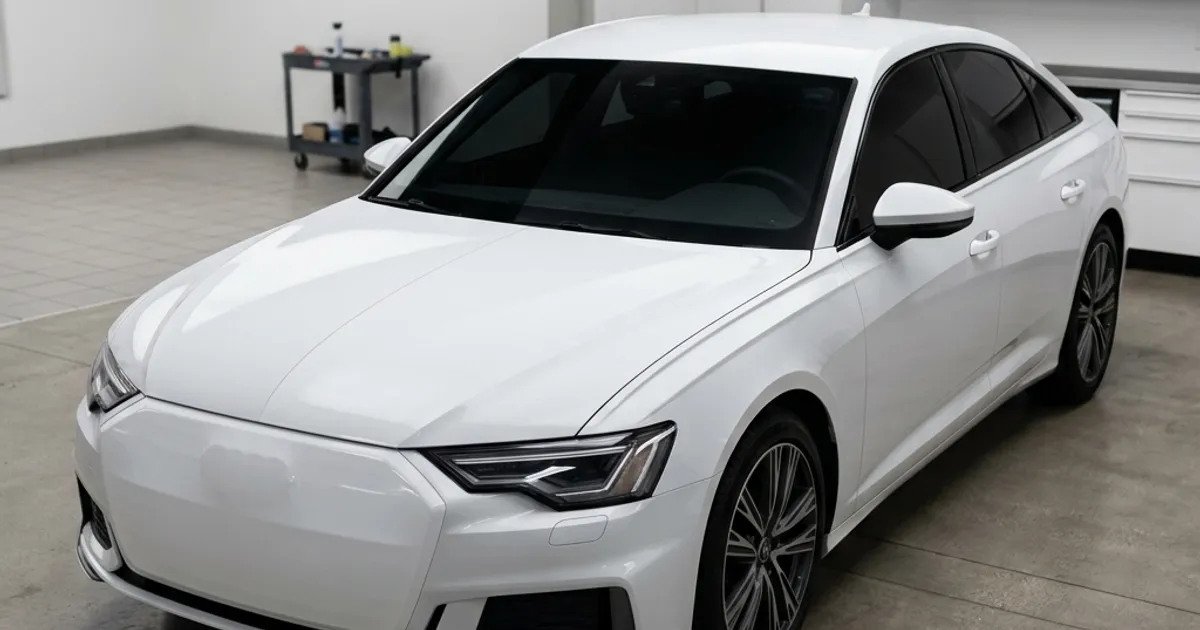
The Four Standard Coverage Levels
There are four standard PPF coverage levels that almost every shop offers:
1. Partial Front — front bumper + 24" of the leading hood. The cheapest entry point. $600-$1,500 depending on vehicle and film.
2. Full Front — front bumper, full hood, full fenders, mirror caps, A-pillars, sometimes headlights. The sweet spot for most owners. $1,500-$3,500.
3. Track Package — full front + rocker panels + rear wheel arches. For drivers who see gravel, dirt or track use. $2,500-$5,000.
4. Full Body — every painted panel wrapped. Reserved for exotic, luxury or collector cars where the asset value justifies the cost. $5,000-$15,000+.
Partial Front: The Bare Minimum
Partial front PPF covers the front bumper and the first 24 inches of the hood (sometimes also the front fenders if the package includes them). This is the cheapest entry point.
It is also where 50-60% of all rock chip damage happens. The bumper takes the most direct impact; the leading edge of the hood catches everything that flies up over the bumper. Together they account for the majority of all PPF claims.
For owners on a tight budget, partial front is a real value. It is not full coverage, but it eliminates the highest-frequency damage zone for under $1,500 on most vehicles.
Full Front: The Sweet Spot
Full front PPF wraps the front bumper, the full hood, the full fenders, the mirror caps, the A-pillars (the vertical pillars on either side of the windshield), and often the headlights.
This is the package that covers 75-85% of all rock chip damage on the average daily driver. Anything that hits the front of the car has to land in one of these areas — and they are all wrapped.
Full front is also where the cost-per-protection curve is most efficient. You are paying maybe 2× the partial front price for 1.5-2× the protection coverage. The next level up (track package) costs 1.5-2× full front for only modest additional protection.
For 80% of new-car PPF buyers, full front is the right answer.
Get free quotes from certified installers in your area
Compare prices and find the right installer for your vehicle.
Get Free Quotes →Track Package: For Specific Use Cases
A track package adds rocker panels and rear wheel arches to a full front. This is targeted at:
- Dirt road and gravel road drivers — where gravel kicks up at all four wheels.
- Track day cars — where rocks come from every angle on a track surface.
- Construction zone commuters — where loose debris is everywhere.
For a normal urban or highway daily driver, the rocker panels and rear arches see relatively little debris compared to the front of the car. The marginal protection is real, but the cost-per-square-inch is significantly higher than full front.
Full Body: For Exotics and Collectors
Full body PPF wraps every painted panel on the car. Doors, quarters, roof, trunk, rear bumper, everything.
The case for full body is mostly about asset preservation, not damage prevention. Doors and quarters do not see many rock chips, but they do see door dings, parking lot damage, casual scuffs and chemical etching. Full body PPF protects against all of these.
For a $30,000 daily driver, full body PPF rarely makes financial sense — the protection cost is 25-50% of the asset value. For a $250,000 exotic, it is 3-6% of the asset value, and the case is much stronger.
Full body PPF is also the only way to fully protect every panel from environmental damage, UV fading and long-term clear coat oxidation.
Cost by Coverage Level (Sedan)
Approximate market pricing for a typical sedan in 2026:
- Partial Front: $600-$1,500
- Full Front: $1,500-$3,500
- Track Package: $2,500-$5,000
- Full Body: $5,000-$10,000+
SUVs and trucks add 25-50% to all of these. Exotics, supercars and full carbon fiber bodies add another 50-100%.
The Diminishing Returns Argument
If you plot protection coverage against cost, full front PPF is clearly the most efficient point on the curve:
- Partial Front protects ~55% of risk for $1,000.
- Full Front protects ~80% of risk for $2,500.
- Track Package protects ~88% of risk for $3,750.
- Full Body protects ~100% of risk for $7,500+.
Going from partial to full front buys you 25 percentage points of protection for $1,500. Going from full front to full body buys you another 20 points for $5,000. The marginal cost per percentage point quadruples.
For most owners, full front is the financially optimal point. Full body is justifiable only when the asset value makes the marginal cost defensible.